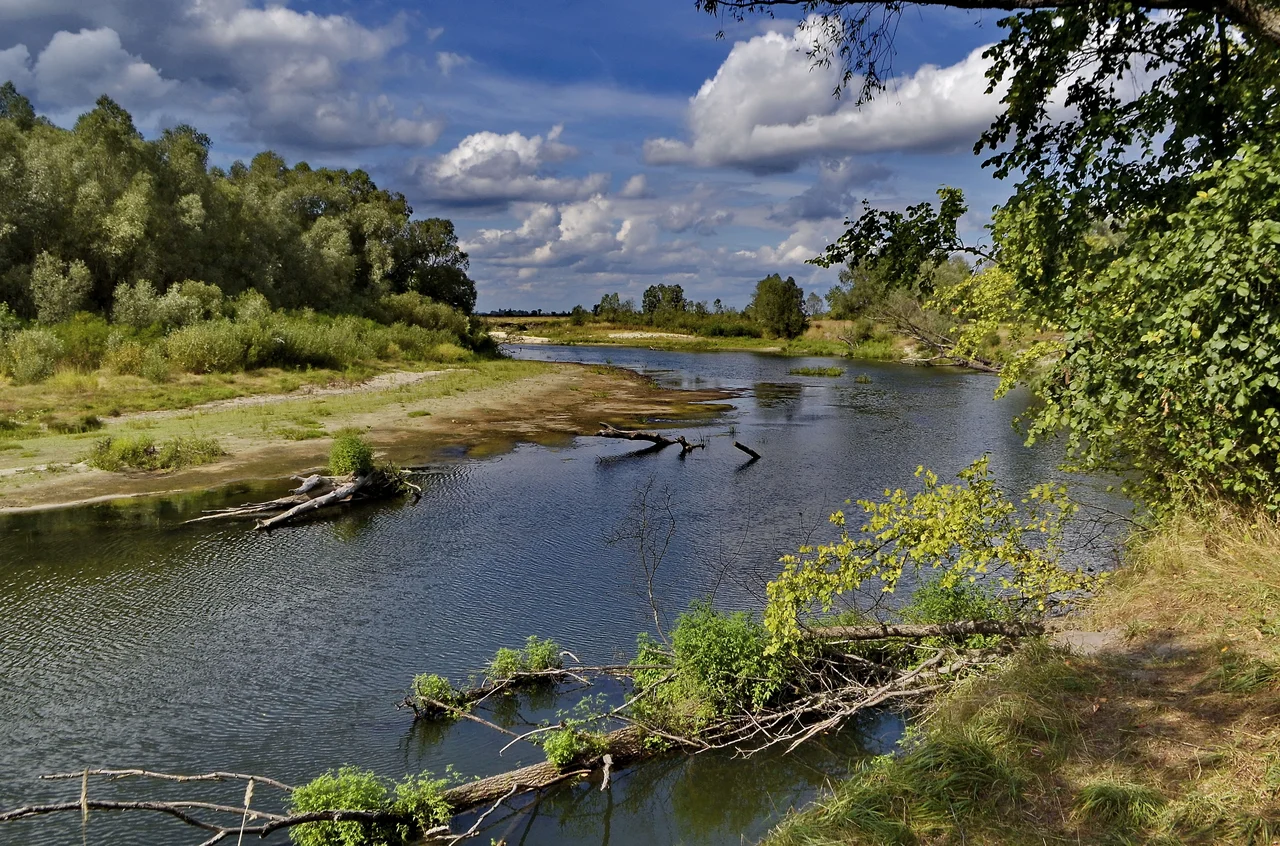

Zalissia National Nature Park
On the map it is called a national park, but for years the gates of Zalissia have not opened the way most parks do. This great sweep of forest on the left bank of the Desna River, only about twenty kilometers northeast of Kyiv, has served a more exclusive purpose: a protected reserve set aside, in the official language, for the reception and stay of senior officials. A decree in 2009 ordered its transition into a traditional national park open to all - yet as of 2017, that change had still not been carried out, and public access remained limited. It is a quiet paradox in the woods: a place preserved so completely, and so privately, that the very forest which makes it worth visiting has long been kept mostly out of reach.
The Forest and the River
Zalissia sits in a landscape shaped by water and terrace. The Desna River meanders along the park's western edge, running north to south, though the channel itself keeps a distance of five to ten kilometers, leaving the forest to spread across the first and second river terraces - the raised, ancient floodplains that step up gently from the water. This is a corner of the Central European mixed forests, the great temperate hardwood belt that stretches across northeastern Europe all the way from Germany to Russia. Here that belt takes the form of dense woodland northeast of the Ukrainian capital, close enough to the city to be reached in an afternoon, yet deep and self-contained enough to feel like a world apart from Kyiv's streets.
A Realm of Old Pines
Walk into Zalissia and you walk into a pine forest. Pines dominate overwhelmingly, covering some 85 percent of the wooded area, their tall trunks and high canopies giving the reserve its character of light and resinous air. Oak fills another 7 percent, alder 5 percent, and a scattering of other species the remaining 3 percent. What makes the forest remarkable is its age: an estimated 1,700 hectares of pine here are more than a century old. Old-growth stands like these are increasingly rare in a Europe long shaped by logging and clearance, and they harbor a maturity that younger woods cannot fake - the deep shade, the fallen giants, the slow ecological richness that only time can grow. In Zalissia, that century-old forest is the treasure the reserve exists to protect.
Kept Apart, Kept Alive
There is an irony at the heart of Zalissia, and perhaps a lesson too. The same restricted status that has frustrated ordinary visitors - its long service as a state retreat rather than an open park - is also what has shielded its forest so thoroughly. Without the foot traffic, development, and pressure that public access often brings, the reserve's old pines and its wildlife have been left largely undisturbed for generations. Administered within Brovary Raion of Kyiv Oblast, the park guards not only trees but the plant and animal life that depends on undisturbed woodland. Whether Zalissia ever fully becomes the public national park its 2009 decree envisioned, its exclusivity has bought something precious in the meantime: a great, aging forest at the capital's doorstep, quietly intact.
From the Air
Zalissia National Nature Park lies at about 50.667 N, 30.850 E in Brovary Raion, Kyiv Oblast, roughly 20 km northeast of Kyiv on the left bank of the Desna River. From the air it reads as a large, unbroken block of dark pine forest set apart from surrounding farmland and settlement, with the meandering Desna to the west. A viewing altitude of 3,000-4,000 feet AGL shows the forest canopy and river terraces well. The nearest airports are Kyiv Boryspil (UKBB) to the south and Kyiv Zhuliany (UKKK) to the southwest.
Nearby Stories
- Paton Bridge 14 km away
- 1995 Borodianka Mid-Air Collision 22 km away
- Chernobyl 32 km away
- Nizhyn 42 km away
- Pereiaslav 44 km away
- Capture of Chernobyl 50 km away
- Arboretum Oleksandriya 72 km away
- Kruty Heroes Memorial 74 km away