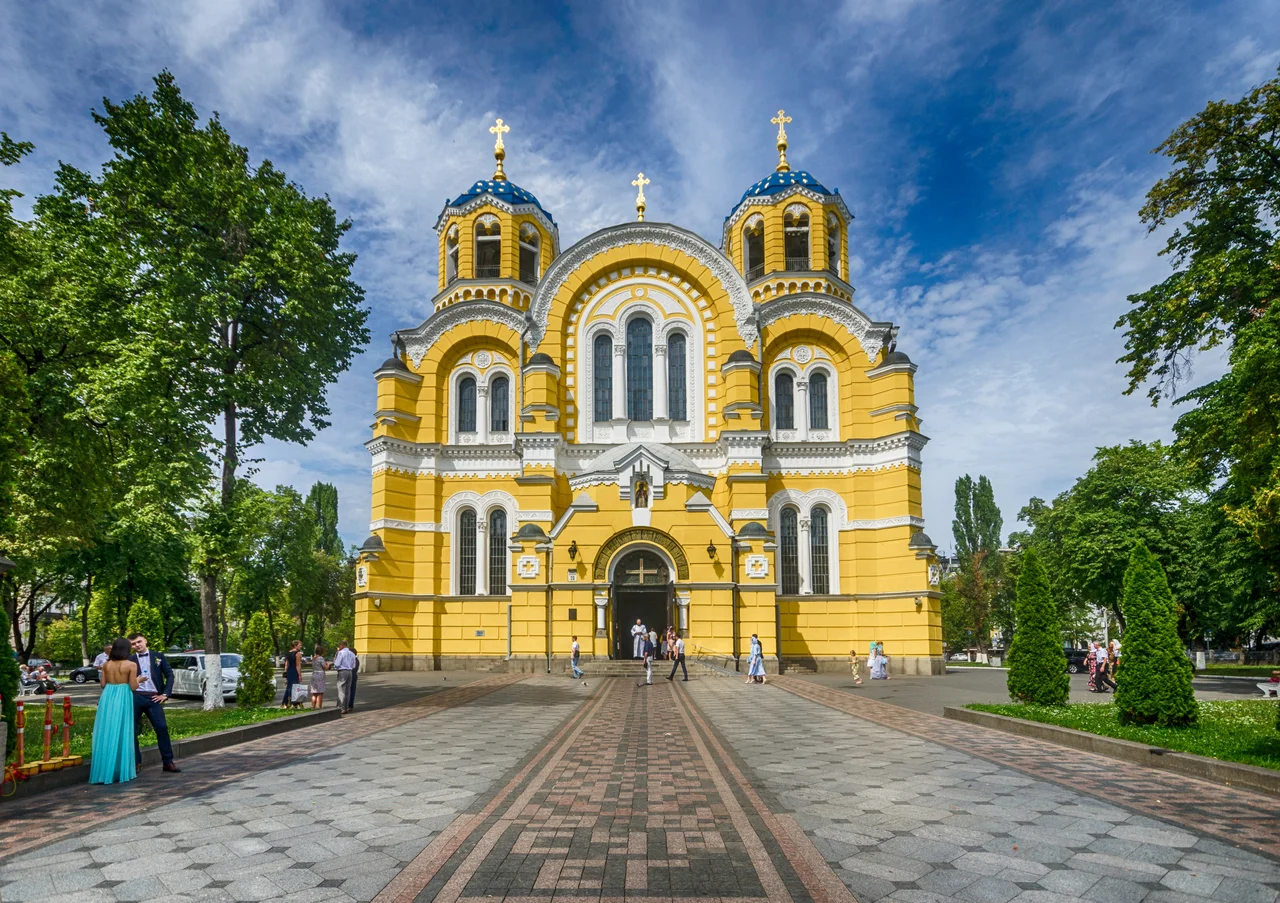

St Volodymyr's Cathedral
For much of the Soviet period, one of Kyiv's most beautiful churches was officially a museum of atheism. Inside, under seven cupolas and across walls covered in gold-ground frescoes, the state displayed exhibits meant to argue that God did not exist, in a building constructed for the express purpose of worshiping Him. St Volodymyr's Cathedral had been raised to celebrate faith, narrowly escaped the wrecking crews that leveled so many Kyiv churches, and was made instead to serve the argument against itself. The murals stayed on the walls the whole time. Whatever the placards said, the saints kept watching.
A Million Bricks
The cathedral began as a milestone. In 1852 a Moscow metropolitan proposed a grand new church in Kyiv to mark the nine hundredth anniversary of the baptism of Kyivan Rus', the moment in the tenth century when Prince Volodymyr the Great converted his realm to Christianity. Donations poured in from across the Russian Empire, reaching a hundred thousand rubles by 1859, and the Kyiv Pechersk Lavra, the ancient Monastery of the Caves, produced a million bricks and gave them to the cause. Several architects worked on the design before the final neo-Byzantine plan settled into its form: a six-piered, three-apsed temple crowned by seven cupolas, rising forty-nine meters to the cross atop the main dome. Completed in 1882, its yellow-walled bulk anchored the boulevard where it still stands.
Painted by Masters
The building is only the frame. What stops visitors is the interior, and it took until 1896 to finish, fourteen years after the walls went up. Mosaicists came from Venice. The vast program of frescoes was directed by Professor Adrian Prakhov and executed by a roster of celebrated painters, among them Viktor Vasnetsov and the visionary Mikhail Vrubel. Vasnetsov's serene, austere image of the Holy Mother of God fills the altar apse, and his scenes of the baptism of the Kyivans run across the walls like a national origin story rendered in paint. The iconostasis was carved from white marble quarried at Carrara in Italy, the same stone Michelangelo used, and the bronze entrance doors carry reliefs of Volodymyr and of Olga of Kyiv, the princess who embraced Christianity before him.
The Church That Survived
The twentieth century tried the cathedral hard. It risked damage in the fighting of 1920, and under Soviet rule it escaped demolition only narrowly, though it could not escape closure and its long humiliation as a museum of religion and atheism. When the Bolsheviks destroyed the nearby St. Michael's Golden-Domed Monastery, the relics of Saint Barbara, a third-century martyr, were carried here for safekeeping, and here they have remained. After the Second World War the cathedral reopened and has stayed open ever since. In a state officially hostile to religion, it became one of the very few working Orthodox churches that foreign visitors could openly enter, a rare candle kept burning, and in 1988 it hosted the millennium celebration of the baptism of Rus' as Soviet policy toward faith finally began to soften.
A Living Cathedral
With the Soviet Union gone, the cathedral's stewardship became contested among branches of Ukrainian Orthodoxy, and control ultimately passed to the Kyiv Patriarchate. Since the unification council of December 2018 it has belonged to the Orthodox Church of Ukraine. Through all these shifts of jurisdiction, the building itself simply endures at the crossroads of Shevchenko Boulevard and Ivan Franko Street, its seven cupolas a fixed point in a changing city. Step inside from the noise of the boulevard and the light drops to gold and shadow, Vasnetsov's Madonna gazing down from the apse. More than a century of politics has washed over these walls, and the frescoes remain exactly what they were painted to be: an act of devotion that outlasted every argument against it.
From the Air
St Volodymyr's Cathedral stands at 50.4449 N, 30.5087 E in central Kyiv's Shevchenkivskyi District, near Taras Shevchenko Boulevard and the Botanical Garden. From 1,500 to 2,500 feet AGL, look for its distinctive yellow walls and cluster of seven dark cupolas amid the downtown streets, not far from the university's red buildings. Nearest airports are Kyiv Zhuliany (UKKK) about 5 km southwest and Boryspil International (UKBB) roughly 33 km east.
Nearby Stories
- Boryspil 1.5 km away
- Zalissia National Nature Park 31 km away
- Trakhtemyriv 32 km away
- Bila Tserkva 40 km away
- Malyn 46 km away
- Radomysl Castle 49 km away
- Nizhyn 81 km away
- Berdychiv 95 km away